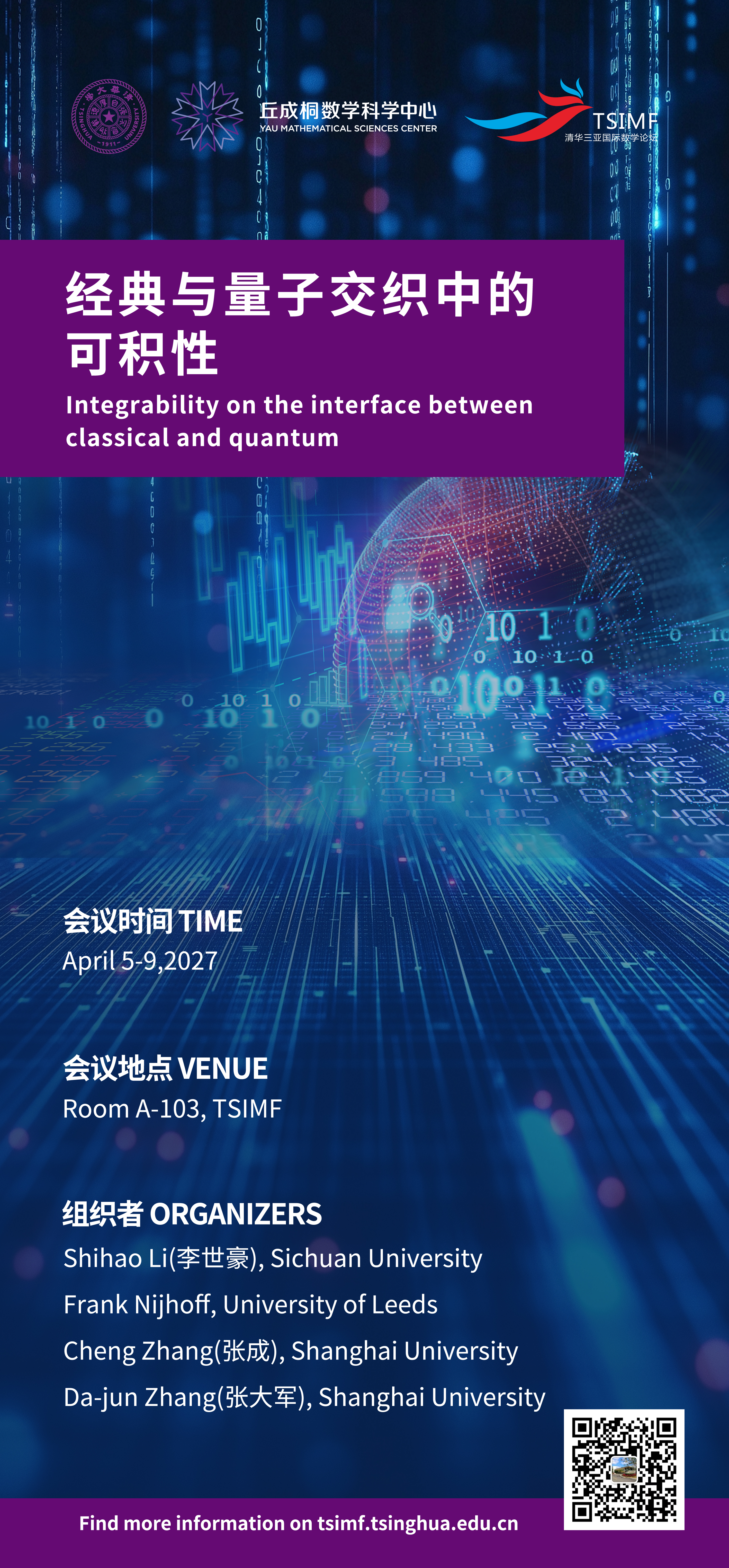
 Organizers
Shihao Li(李世豪), Sichuan University ✉ 🌐
Frank Nijhoff, University of Leeds ✉ ✉ 🌐
Cheng Zhang(张成), Shanghai University ✉
Da-jun Zhang(张大军), Shanghai University ✉ 🌐
Abstract
It is known, but hardly ever explicitly realised as a structural aspect, that in the field of integrable systems the quantum and classical formalisms are heavily interlinked in a way that goes well beyond the usual `classical correspondence' (i.e., the limit that the Planck constant tends to zero), and in fact forms an essential part of the integrable structure on both levels. The remarkable appearance of the quantum R-matrix in various manifestations of the classical theory for discrete integrable systems is one of those phenomena. Here the discrete time-step parameter takes over the role of the Planck constant. Another is the way in which quantum and classical aspects coexist in so-called `hybrid systems’. Recently, in classical mappings derived from soliton lattices the associative Yang-Baxter equation emerged, with novel solutions that govern both the classical and quantum theory of those discrete dynamical systems. The workshop intends to focus on these novel manifestations of classical/quantum duality, and bring together experts with the aim to understand the consequences of this duality for the understanding of quantum mechanics in general, as well as to explore ways to use them as potential calculational tools, e.g. in the path integral quantization of integrable theories.