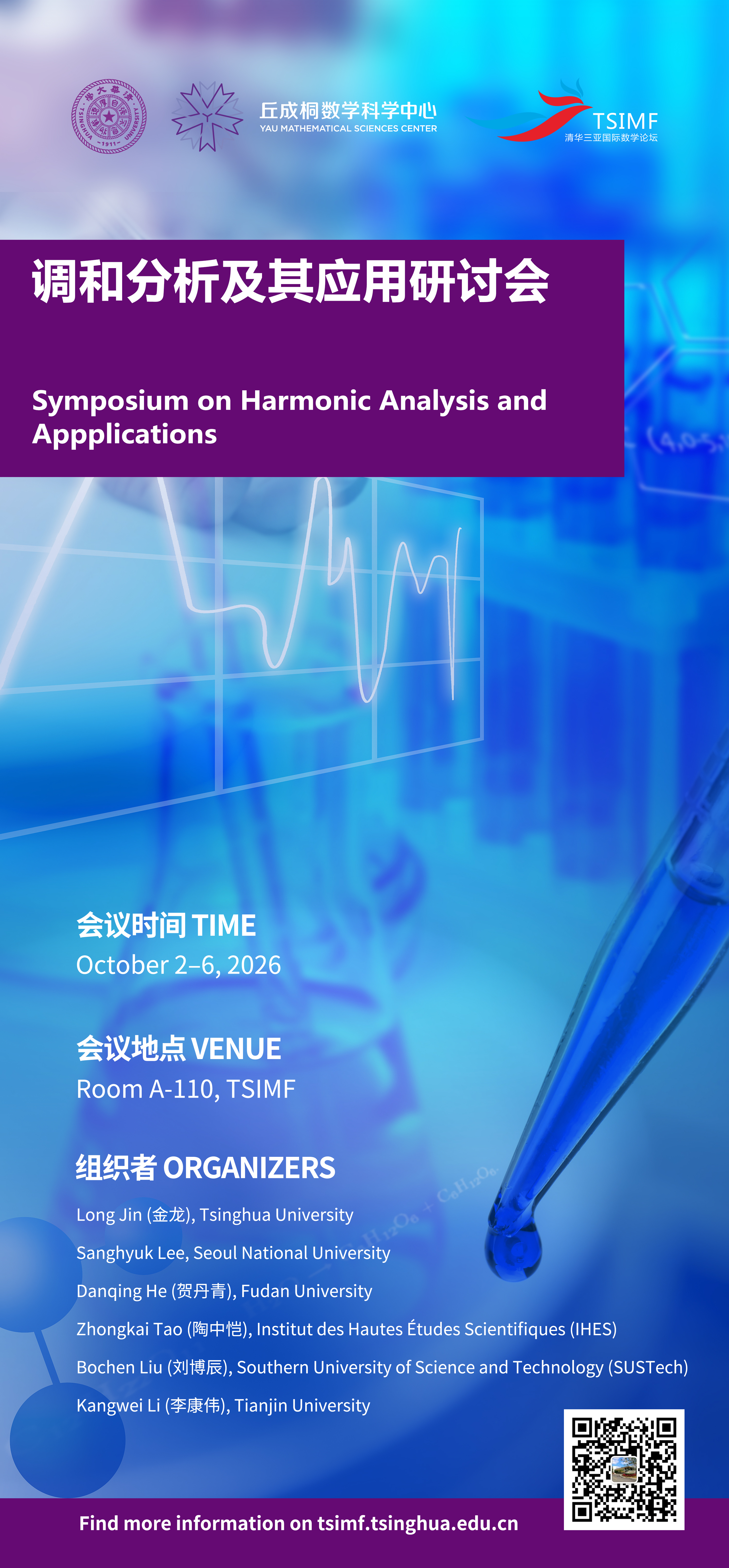
 Organizers
Long Jin (金龙), Tsinghua University ✉ 🌐
Sanghyuk Lee, Seoul National University ✉ 🌐
Danqing He(贺丹青), Fudan University ✉ 🌐
Zhongkai Tao(陶中恺), Institut des Hautes Études Scientifiques (IHES) ✉ 🌐
Bochen Liu(刘博辰), Southern University of Science and Technology (SUSTech) ✉ 🌐
Kangwei Li(李康伟), Tianjin University ✉ 🌐
Abstract
This symposium focuses on recent advances in harmonic analysis and its significant applications in related mathematical branches. It systematically traces the field's development since the inception of Fourier series theory and elucidates its pivotal role in modern mathematics.
Originating from analytical tools pioneered by Fourier in his study of the heat equation, harmonic analysis has evolved over two centuries. Its core research scope has expanded from classical problems such as the convergence of Fourier series to modern frontiers including high-dimensional oscillatory integral estimates and singular integral operator theory. In recent years, tools from algebraic geometry, additive combinatorics, and other fields have been introduced into harmonic analysis research, driving breakthroughs in major problems such as the Bochner-Riesz conjecture, restriction conjecture, and Furstenberg–Bergelson–Leibman conjecture, while resolving the local smoothing conjecture and Kakeya conjecture in three-dimensional space. Concurrently, significant applications of related theories in problems like the Vinogradov mean value theorem, pointwise convergence of solutions to the Schrödinger equation, Falconer distance conjecture, and Roth theorem collectively signify that the field is undergoing a dual expansion in both theoretical depth and breadth.
The conference will invite experts in harmonic analysis and related fields from both China and abroad to present their latest research findings and to explore in depth the extensive connections between harmonic analysis and mathematical branches such as number theory, geometric measure theory, and additive combinatorics.