 Organizers
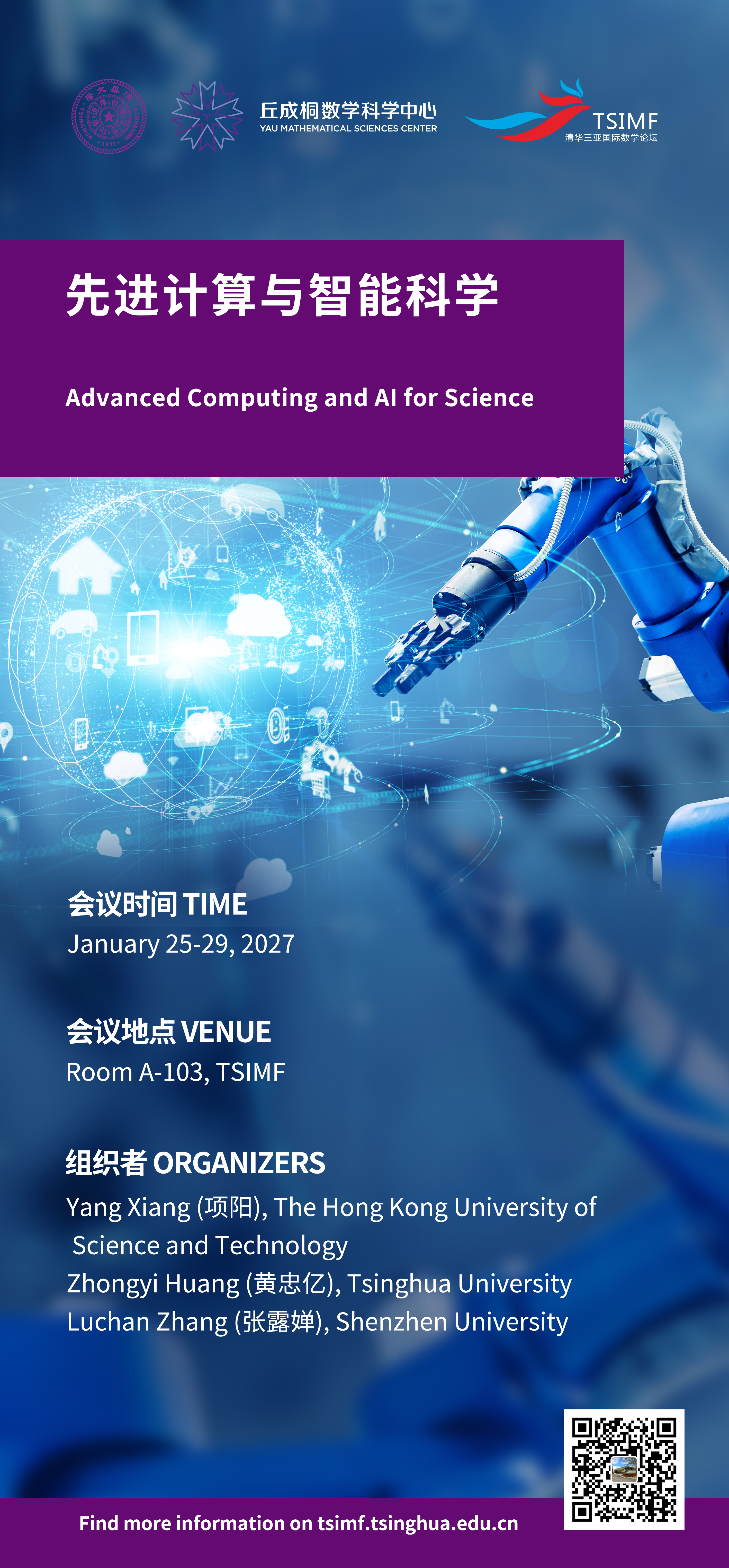
Yang Xiang (项阳), The Hong Kong University of Science and Technology ✉
Zhongyi Huang (黄忠亿), Tsinghua University ✉
Luchan Zhang (张露婵), Shenzhen University ✉
Abstract
Advanced computing and AI for science represent key frontiers in contemporary science, and their advancement fundamentally depends on efficient, stable, and high-precision computational mathematics methods. The development of this field is closely linked to various national strategic needs, including high-end equipment manufacturing, aerospace, climate prediction, new energy development, biomedicine, and artificial intelligence infrastructure, all of which demand efficient and reliable numerical computing capabilities. In recent years, driven by the growing demands of large-scale scientific computing, complex system simulation, multiscale problem solving, and big data modeling, computational mathematics has achieved systematic progress in areas such as novel finite element and finite difference schemes, high-order spectral methods, adaptive mesh techniques, preconditioning techniques for iterative methods, and sparse and low-rank numerical algebra. Meanwhile, machine learning and AI algorithms have provided new research avenues for numerical modeling, parameter inversion, reduced-order approximation, and error correction, gradually giving rise to a new research paradigm that organically integrates numerical methods with data intelligence. To foster academic exchange and collaborative innovation in computational mathematics, and to promote the complementary strengths of traditional numerical algorithms and neural network approaches, this conference focuses on core topics including advanced computational mathematics theory, efficient numerical algorithm design, large-scale scientific computing, multiscale modeling, machine learning and AI-assisted scientific computation numerical analysis. The conference will bring together domestic experts and scholars working in computational mathematics and related interdisciplinary fields to engage in in-depth discussions on cutting-edge research problems, exchange recent findings, explore how the integration of computational mathematics and intelligent science can better serve national strategic needs, and advance the development of the discipline.