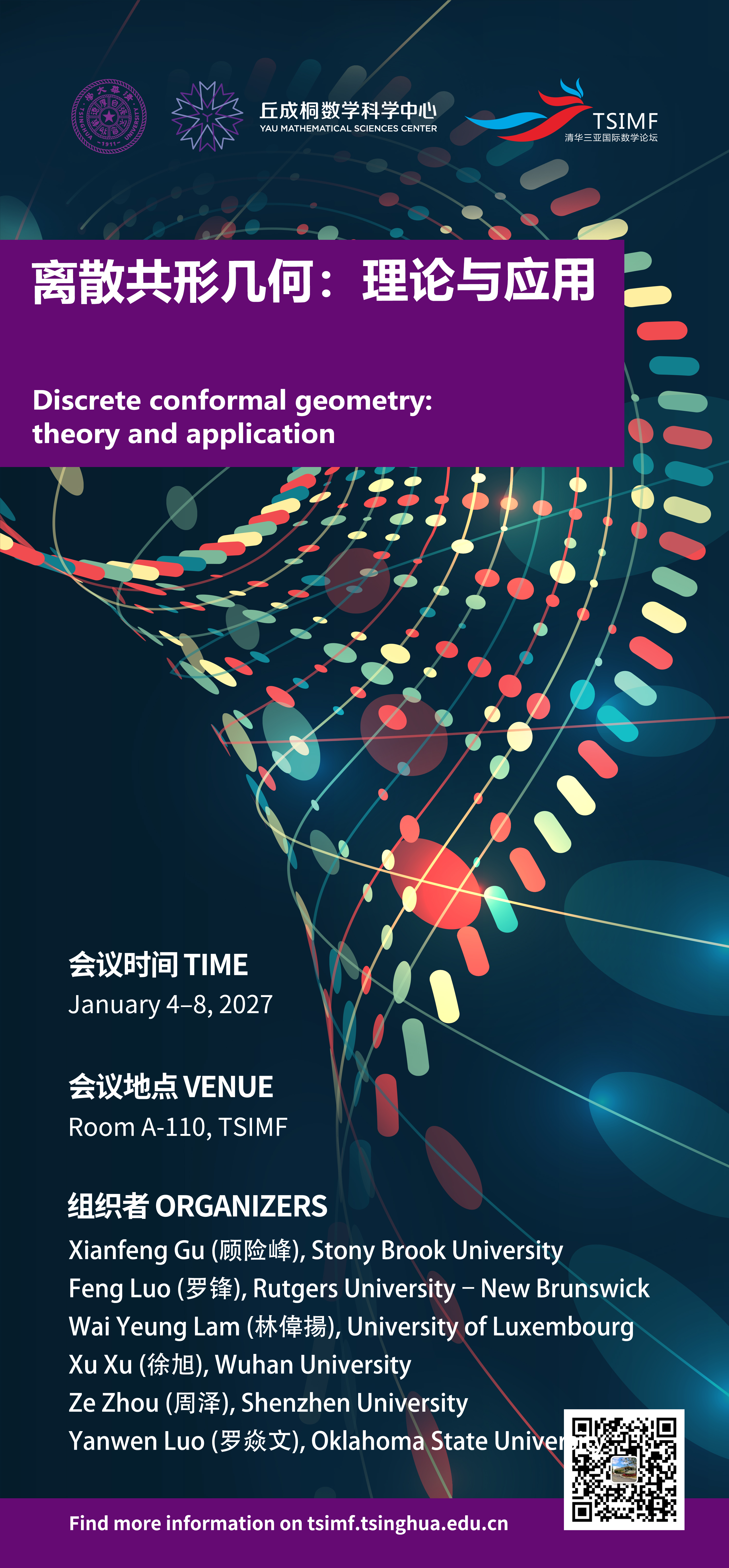
 Organizers
Xianfeng Gu (顾险峰), Stony Brook University ✉ 🌐
Feng Luo (罗锋), Rutgers University–New Brunswick ✉ 🌐
Wai Yeung Lam (林偉揚), University of Luxembourg ✉ 🌐
Xu Xu (徐旭), Wuhan University ✉ 🌐
Ze Zhou (周泽), Shenzhen University ✉ 🌐
Yanwen Luo (罗焱文), Oklahoma State Universit ✉ 🌐
Abstract
Driven by the rapid advancement of digital technology, an unprecedented volume of images and surface data is now produced through smartphones, 3D scanners, and related tools. This creates an urgent demand for methods to analyze, classify, and compare such data, much of which is represented by discrete surfaces, including triangular and quadrilateral meshes. This demand has spurred the development of the structure-preserving discrete theory of surfaces. By encoding smooth geometric structures into discrete models that preserve their essential properties, this theory provides both rigorous mathematical foundations and versatile computational frameworks. A prominent example is circle packing, introduced by Fields Medalist William Thurston, which serves as a structure-preserving discretization of conformal geometry, giving birth to the field of discrete conformal geometry.
In recent years, this area has seen striking progress, ranging from theoretical breakthroughs—such as discrete Riemann mapping theorems and discrete uniformization theorems—to diverse applications in computer vision, biological imaging, and brain mapping. At the same time, deep interactions with probability theory, combinatorics, and mathematical physics are driving the discovery of novel discrete models and theories related to conformal geometry.
This workshop aims to bring together international researchers from multiple disciplines to present recent advances, foster new collaborations, and highlight open problems surrounding discrete theories of surfaces, their connections with other fields, and their potential applications in computer science and materials design.
We will invite contributors to a special issue of the brand-new journal Beijing Journal of Pure and Applied Mathematics on ``Discrete Geometry, Discrete Ricci flow, Computational Conformal Geometry, and Applications in Memory of Professor Richard S. Hamilton" to share their latest progress in this field.