 Organizers
Stephen S.-T. Yau (丘成栋), Tsinghua University ✉ 🌐
Guowei Wei (魏国卫), Michigan State University ✉ 🌐
Shan Zhao (赵山), University of Alabama ✉ 🌐
Chenglong Yu (于成龙), Monash University ✉ 🌐
Description of Activity
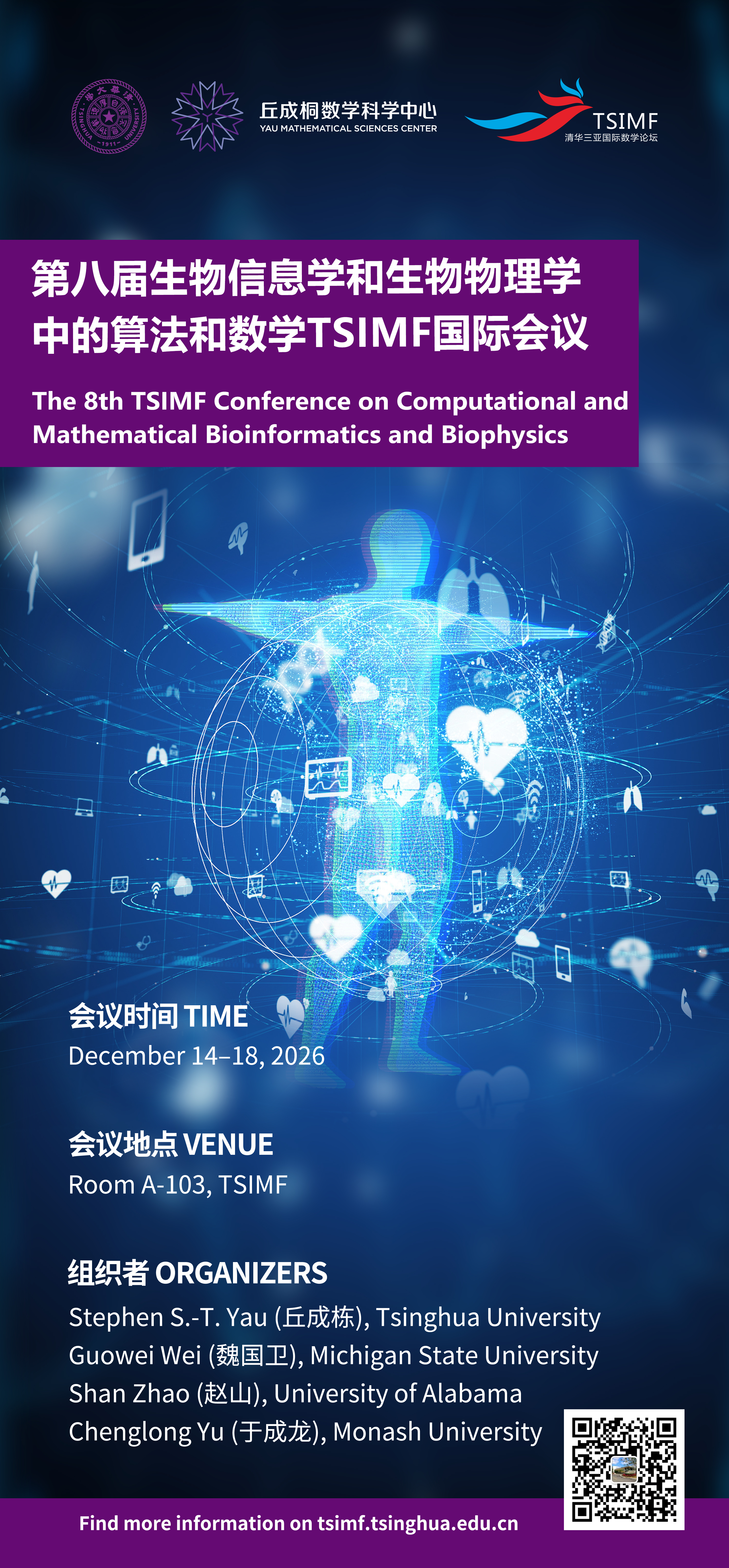
We propose the 8th TSIMF Conference on Computational and Mathematical Biophysics and Bioinformatics to be held at Tsinghua Sanya International Mathematics Forum (TSIMF) in the December 2026.
Rationale
The proposed workshop on “Computational and Mathematical Biophysics and Bioinformatics” will bring together researchers from mathematics, biostatistics, chemistry, biochemistry, biophysics, and molecular/cell biology to explore new ways to bridge these diverse disciplines, and to facilitate the use of mathematics to solve open problems at the forefront of the biophysics and bioinformatics.
An important trend in contemporary life sciences is that with the availability of modern biotechnologies, traditional disciplines, such as physiology, plant biology, neuroscience etc., are undergoing a fundamental transition from macroscopic phenomenological ones into molecular based biosciences. In parallel with this development, a major feature of life sciences in the 21st century is their transformation from phenomenological and descriptive disciplines to quantitative and predictive ones. Revolutionary opportunities have emerged for mathematically driven advances in biological research. Experimental exploration of self-organizing molecular and cellular biological systems, such as SARS-CoV-2, molecular motors and proteins in Alzheimer's disease, are examples of dominating driving forces in scientific discovery and innovation in the past few decades. However, the emergence of excessive complexity in self-organizing biological systems poses fundamental challenges to their quantitative description, because of the excessively high dimensionality and the complexity of the processes involved. Mathematical approaches that are able to efficiently reduce the number of degrees of freedom, and model complex biological systems, are becoming increasingly popular in biosciences. Multiscale modeling, manifold extraction, sequencing analysis, topological simplification, dimensionality reduction and machine learning techniques are introduced to reduce the complexity of biological systems while maintaining an essential and adequate description of the molecules and cells of interest.
Scope
The workshop will cover a wide range of topics in mathematical modeling of biophysics and bioinformatics, and their applications to specific research problems. Example topics include comparative analysis of human genome and molecular evolution, mechanism of bacterial drug resistance, genome variation polymorphism, genome correlation of important diseases, single-cell sequencing analysis, high-throughput gene sequencing analysis, differential geometry based multiscale models, topological simplification of biomolecules, GLMY homology, natural vectors, Yau-Hausdorff distance, geometric algebra, knot theory of DNA, RNA and proteins, implicit solvation models, Poisson-Boltzmann equation, generalized Born models, polarizable continuum models, integral equation models, density functional methods, Poisson-Nernst-Planck equations, Micro-macro models, continuum-discrete models, microfluidics, biomolecular transport, multiscale Brownian dynamics, electrokinetics, electrohydrodynamics, quantum mechanics, molecular mechanics, and coarse-grained models. Emphasis will be placed on the application of the aforementioned models, theories and methods to precision medicine, early warning of virus and microorganism disasters, large data database construction and retrieval technology for genomic, proteomic, spatiotemporal single-cell transcriptomic data processing, pharmaceutical software technology, DNA packing, DNA-protein interaction, protein-protein interaction, protein-ligand interaction, mathematical AI for biosciences, topological deep learning for biosciences, single-cell RNA sequence analysis, spatial transcriptome data, multiomic analysis, ion channel dynamics, ionic transport in nanopore membranes, rational drug design, drug discovery and delivery, macromolecular self assembly and dynamics of molecular motors.