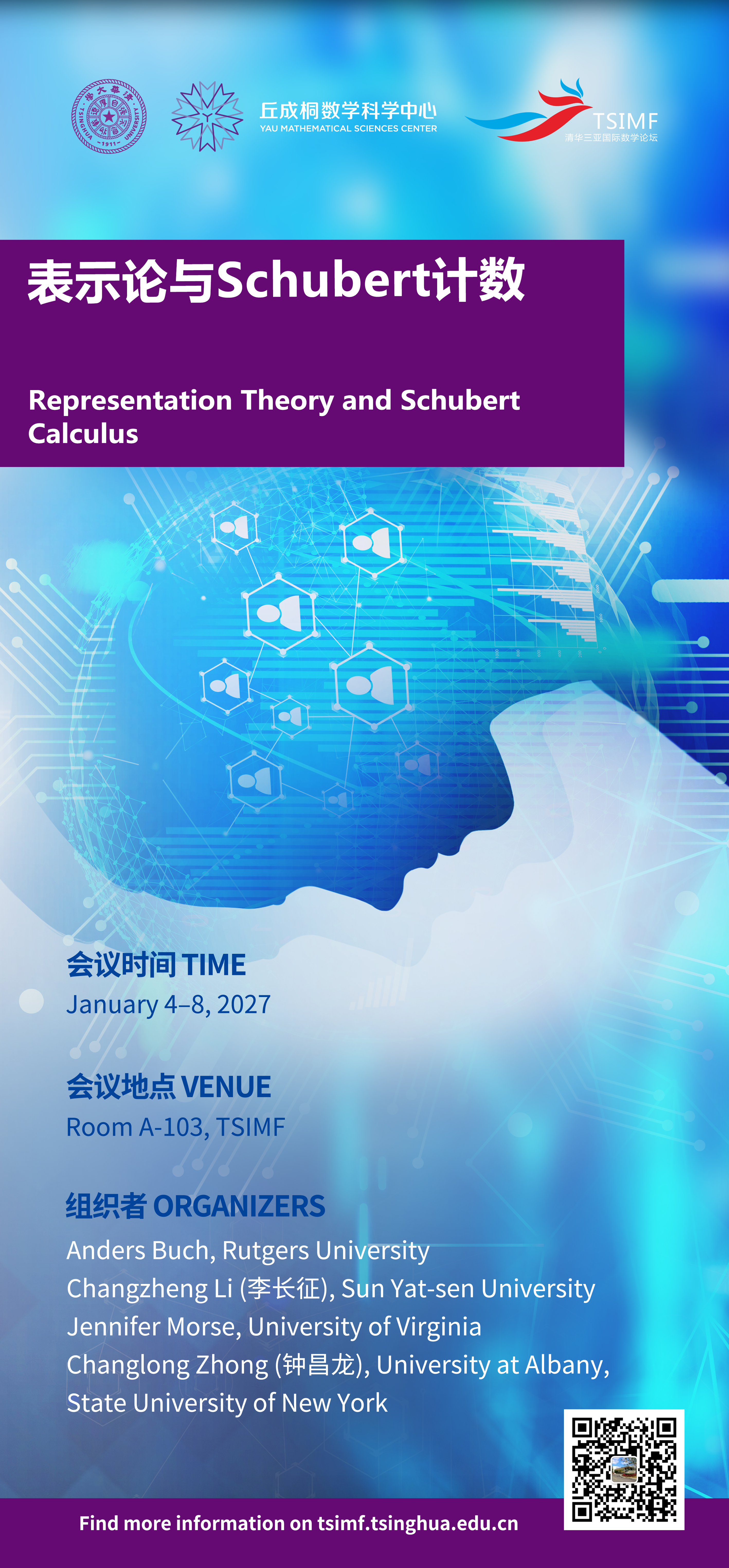
Organizers
Anders Buch, Rutgers University ✉
Changzheng Li (李长征), Sun Yat-sen University ✉
Jennifer Morse, University of Virginia ✉
Changlong Zhong (钟昌龙), University at Albany, State University of New York ✉
Abstract
Representation theory studies algebraic and quantum symmetries through linear transformations of groups, Lie algebras, and quantum algebras. Geometric approaches, particularly via algebraic and symplectic varieties, translate abstract problems into concrete geometric frameworks, while combinatorial models like tableaux and graphs compute structure constants and positivity phenomena.
Symplectic resolutions and flag varieties $G/B$ play central roles in the interplay between representation theory, mathematical physics, and combinatorics. The Springer resolution connects the cohomology of flag varieties to representations of Weyl groups, producing canonical bases, while Nakajima quiver varieties realize highest-weight modules for Kac–Moody and quantum affine algebras. In this framework, convolution algebras drive categorification and reveal deep links to Coulomb branch constructions.
Schubert calculus, both classical and quantum, intertwines these with combinatorial structures. Pieri-Chevalley and Giambelli formulas compute Schubert class products in the cohomology ring of a flag variety, addressing enumerative questions, while Grothendieck polynomials extend this to K-theory. Quantum cohomology and K-theory incorporate rational curve counts, deforming products via Gromov-Witten invariants. Recent advances, like alternating sign positivity in quantum Pieri-Chevalley formulas and Kato's K-theoretic Peterson isomorphism, connect localized quantum K-theory of flag varieties to equivariant K-theory of semi-infinite flag manifolds.
There have been several Chinese mathematicians who made important contributions to Schubert calculus. Prof. Peng Shan has made significant advances in the categorification of double affine Hecke algebras and quantum loop algebras. Prof. Haibao Duan in Chinese Academy of Sciences provided an innovative formula for the classical Schubert constants. Prof. Naichung Conan Leung in the Chinese University of Hong Kong and Prof. Changzheng Li in Sun Yat-sen University investigated the functorial properties among the quantum cohomology of flag varieties, which was applied to obtain new quantum Pieri formulas for isotropic Grassmannians. Prof. Changjian Su in Tsinghua University worked on Chern-Schwartz-MacPherson and motivic Chern classes, which deepens connections between intersection theory, characteristic classes, and enumerative geometry, thus enriching algebraic geometry and K-theory. These advances make Schubert calculus more algorithmic and broadly applicable in topology and representation theory.