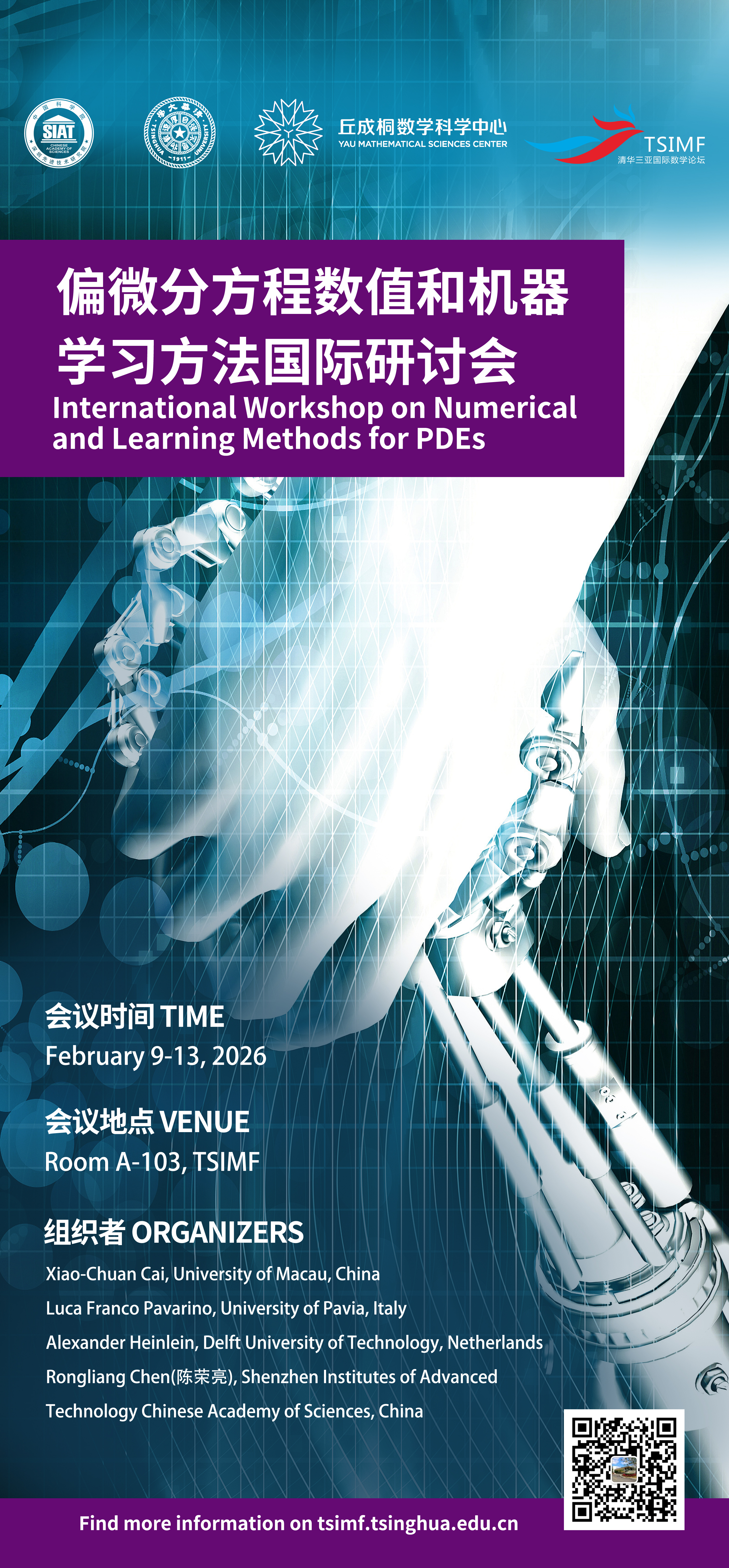
 Organizers
Xiao-Chuan Cai(蔡小川), University of Macau, China
Luca Franco Pavarino, University of Pavia, Italy
Alexander Heinlein, Delft University of Technology, Netherlands
Rongliang Chen(陈荣亮), Shenzhen Institutes of Advanced Technology Chinese Academy of Sciences, China
Abstract
The topic of this conference is the integration of traditional numerical methods and modern machine learning techniques for solving Partial Differential Equations (PDEs), which are fundamental to many scientific and engineering problems. The International Workshop on Numerical and Learning Methods for PDEs brings together mathematicians, computer scientists, and domain experts to explore innovative approaches for developing accurate, efficient, and scalable PDE solvers.
The workshop will focus on four key themes:
1. Advanced Numerical Methods: We will discuss recent progress in finite difference, finite element, and spectral methods, tailored for high-performance computing architectures. Topics include domain decomposition, multigrid methods, and high-order schemes for complex nonlinear PDEs, with an emphasis on exascale computing applications.
2. Machine Learning for PDEs: The conference will examine how neural networks, such as physics-informed neural networks and neural operators, advance PDE solutions. Sessions will cover theoretical foundations and practical implementations of these data-driven approaches.
3. Hybrid Numerical-ML Approaches: We will explore methods combining classical numerical techniques with machine learning, including ML-accelerated multiscale modeling, neural network preconditioners, and differentiable programming for PDE-constrained optimization.
4. Real-World Applications: The workshop will highlight applications in computational fluid dynamics, medical imaging, computational cardiology, and climate modeling, demonstrating how hybrid numerical-ML methods address complex challenges.
Through keynote lectures, technical sessions, and interactive discussions, this workshop provides a platform for researchers from academia, national labs, and industry to share insights, collaborate, and shape the future of computational mathematics. Attendees will engage with advanced tools, explore new methodologies, and contribute to discussions on the role of machine learning in PDE research.
Description of the aim
The aim of the International Workshop on Numerical and Learning Methods for PDEs is to unite researchers in numerical analysis, scientific computing, and machine learning to advance methods for solving Partial Differential Equations (PDEs), which are essential for modeling phenomena in science and engineering, such as fluid dynamics, climate systems, and biomedical processes. Despite progress in numerical methods, challenges persist in creating efficient, accurate, and scalable solvers for complex, data-driven, or multiphysics problems. This workshop provides a platform to explore new developments, foster collaboration, and shape future research in PDE solvers.
Objectives
1. Integrate Numerical and Machine Learning Methods: The workshop will examine advances in numerical techniques, such as adaptive mesh refinement, domain decomposition, and high-order discretizations, alongside machine learning approaches like physics-informed neural networks, neural operators, and reinforcement learning for PDE control. Emphasis will be placed on hybrid methods, including ML-enhanced multigrid solvers, neural preconditioners, and differentiable programming for inverse problems.
2. Highlight Applications Across Domains: Sessions will showcase how advanced PDE solvers address real-world problems, including climate modeling, patient-specific hemodynamics, computational cardiology, aerospace fluid-structure interactions, and seismic imaging. These case studies will discuss both successes and challenges in applying hybrid numerical-ML methods to practical problems.
3. Encourage Interdisciplinary Collaboration: The program includes panel discussions, networking sessions, and collaborative workshops to connect mathematicians, computational scientists, and domain experts, fostering partnerships across academia, national labs, and industry.
4. Shape Future Directions: Discussions will focus on open challenges, such as theoretical guarantees for ML-based solvers, uncertainty quantification, and algorithms for emerging computing architectures (e.g., quantum or neuromorphic). The workshop aims to produce a white paper outlining research priorities and standardized benchmarks.
Thematic Focus
1. Scalability: Algorithms optimized for modern supercomputers and distributed systems.
2. Robustness: Methods for handling noisy or incomplete data in real-world applications.
3. Reproducibility: Development of open-source tools and benchmarks to support community progress.
4. Accessibility: Resources to make numerical-ML methods approachable for diverse researchers.
Expected Outcomes
The workshop seeks to:
Identify promising research directions at the numerical-ML interface. Foster new collaborations across disciplines.
Develop open-source tools and educational resources.
Produce a white paper summarizing key insights and future priorities.
This workshop offers a unique opportunity for researchers at all career stages to contribute to the evolving field of computational mathe matics, where numerical and machine learning methods converge to tackle complex PDE-based problems.