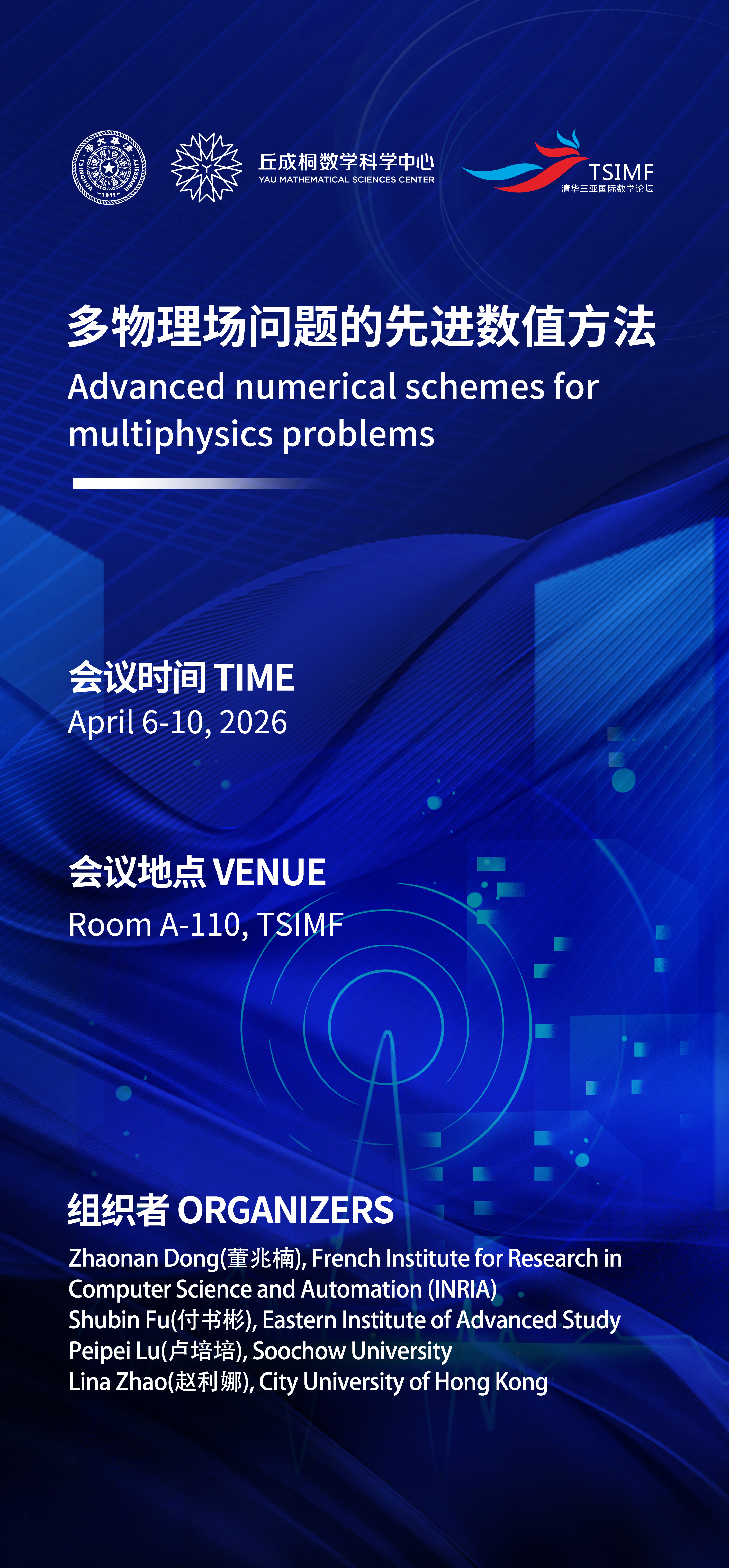
 Organizers
Zhaonan Dong(董兆楠), French Institute for Research in Computer Science and Automation(INRIA)
Shubin Fu(付书彬), Eastern Institute of Advanced Study
Peipei Lu(卢培培), Soochow University
Lina Zhao(赵利娜), City University of Hong Kong
Abstract
The theme of this workshop is “Advanced Numerical Schemes for Multiphysics Problems,” with a dedicated focus on adaptive numerical methods driven by a posteriori error estimates and multiscale methods for complex systems involving physical phenomena. The event will convene internationally renowned scholars in applied mathematics to present breakthroughs in error control for adaptive algorithms, hybrid multiscale frameworks, and their potential applications. The workshop will foster in-depth dialogue on cutting-edge strategies to enhance accuracy, efficiency, and scalability in multiphysics simulations. By uniting theoretical insights with practical challenges, this event aims to significantly advance the exchange of cutting-edge research trends, stimulate interdisciplinary collaboration, and empower participants—particularly early-career researchers—with innovative tools to address pressing scientific problems.
Description of the aim
The numerical simulation of multiphysics problems, characterized by physical phenomena across disparate scales, poses significant theoretical and computational challenges. For systems amenable to derive the a posteriori error estimates, adaptive algorithm strategies can rigorously quantify and control numerical approximation accuracy, optimizing computational efficiency. However, for problems dominated by multiscale interactions—such as those involving heterogeneous materials, fluid-structure coupling, or reactive transport—traditional error frameworks often fail to resolve cross-scale dependencies, necessitating novel multiscale or reduced-order methodologies. This workshop aims to unite experts in adaptive algorithms driven by a posteriori error estimates and multiscale numerical schemes to collaboratively address these dual challenges. By fostering dialogue between theorists developing rigorous a posteriori error estimators and practitioners designing scalable multiscale solvers, the event will advance robust, high-fidelity computational tools for multiphysics applications in geosciences, electromagnetism, energy systems, and biomechanics. The discussions will not only bridge gaps between methodology and implementation but also underscore the practical significance