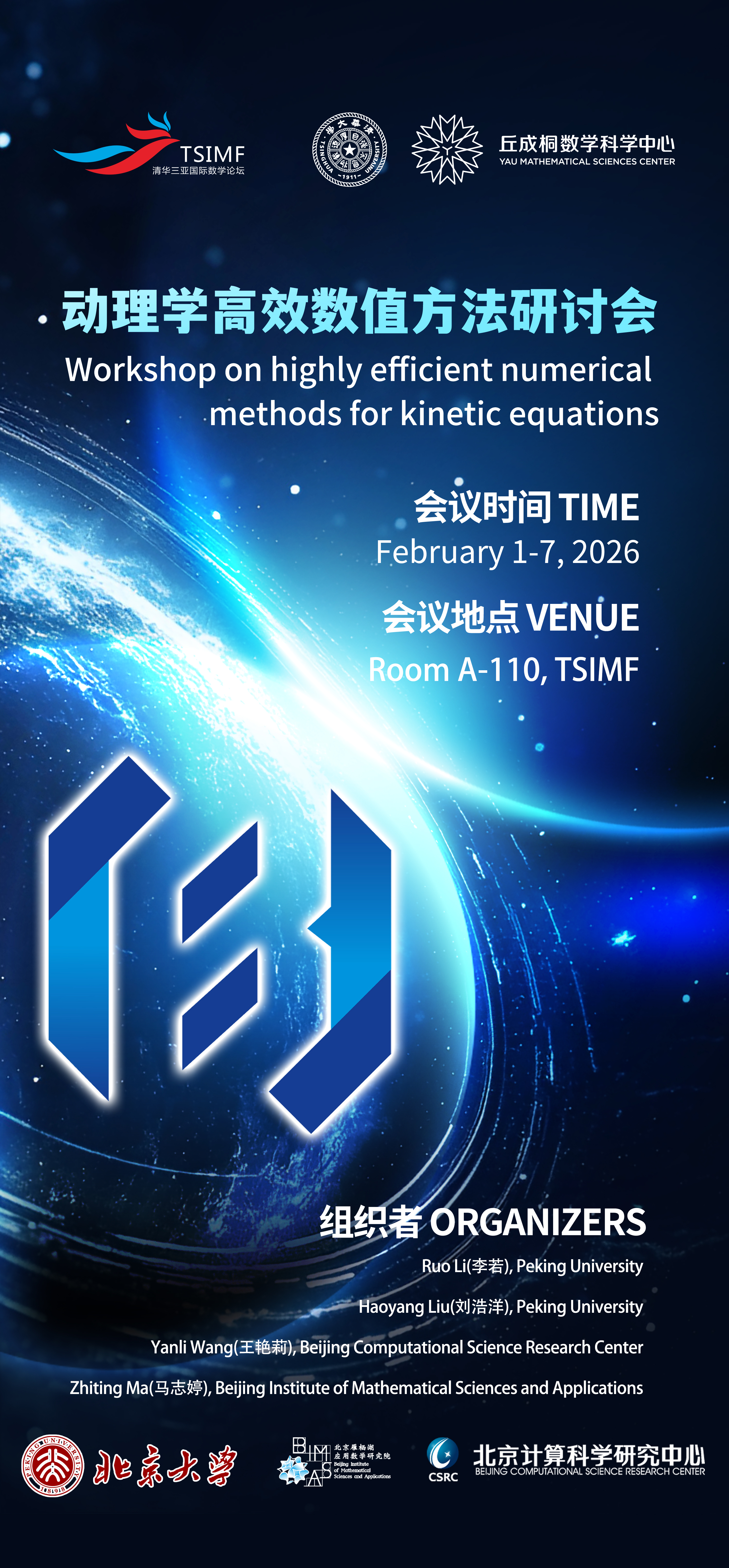
 Organizers
Ruo Li(李若), Peking University
Haoyang Liu(刘浩洋), Peking University
Yanli Wang(王艳莉), Beijing Computational Science Research Center
Zhiting Ma(马志婷), Beijing Institute of Mathematical Sciences and Applications
Abstract
Kinetic theory plays a vital role in a wide range of high-tech fields, including space exploration, plasma physics, and microscale flows. However, directly solving the governing equations—such as the Boltzmann equation—remains computationally expensive and often impractical for large-scale systems. To address this challenge, researchers have been developing highly efficient numerical solvers and exploring simplified model alternatives.
The numerical difficulties encountered in different application areas vary significantly and are often hard to tackle. Nonetheless, methods developed for the Boltzmann equation are now being extended and applied to related problems, including radiative transfer, plasma, etc.
In recent years, research on direct Boltzmann solvers, model reduction techniques, and their diverse applications has become increasingly active. This workshop aims to bring together leading researchers from around the world to present their latest advancements, share insights, and foster collaboration within the kinetic theory community.
Description of the aim
Kinetic theory plays a foundational role in a wide range of fields, including gas dynamics, plasma physics, and radiative transfer, and serves as a critical theoretical underpinning for advanced engineering applications such as inertial confinement fusion and hypersonic vehicle design. A major challenge in this area lies in the inherently multiscale nature of particle transport: the governing equations vary fundamentally across physical regimes, transitioning from the Boltzmann equation at the molecular mean free path scale to the Navier–Stokes equations under continuum assumptions.
Recent advances in the study of Hilbert’s Sixth Problem have led to a deeper mathematical understanding of the consistency between models across these scales. However, from a numerical perspective, developing algorithms that are both highly accurate and adaptive across different regimes remains a significant open problem in the field of multiscale kinetic computation.
This workshop aims to highlight recent progress in efficient numerical methods for kinetic equations and to explore their applications in complex engineering systems. It will bring together leading international experts to exchange the latest research developments, address practical computational challenges, and foster collaboration at the intersection of kinetic theory, applied mathematics, and engineering innovation.